
Flagship initiative
Regional Universities Partnership for Sustainable Agriculture
Collaborating for food security, climate resilience and rural livelihoods in Africa.
- Thematic areas
- Agriculture, water, energy, climate resilience and technology
- Geographic focus
- Southern Africa, starting with Zimbabwe, Eswatini and South Africa
- Target partners
- Universities and research institutions, government, industry, development partners and communities
- SDG alignment
- SDGs 1, 2, 6, 7 and 13, delivered through SDG 17
The proposition
Regional universities that research, apply and deliver together will win more funding for sustainable agriculture and change more lives than any of them could alone.
Universities hold scientific expertise, research infrastructure, students, land and laboratories, and relationships with communities, governments and industry. But that expertise is spread across institutions, and limited collaboration, funding constraints and gaps between research and implementation hold it back.
The partnership connects strengths across agriculture, water management, renewable energy, environmental engineering and digital technology. It helps institutions find shared priorities, develop joint proposals, strengthen grant management and turn research into practical solutions for farmers and rural communities.
Overall objective
To strengthen the collective capacity of regional universities to secure funding for, and deliver, sustainable agriculture solutions.
Regional map
SVG illustration
- 1
Establish a regional consortium of universities and stakeholders around shared sustainable agriculture priorities.
- 2
Strengthen institutional capacity in grant writing, grant management and project management.
- 3
Develop and submit competitive joint funding proposals.
- 4
Translate research into community-based demonstrations of integrated food, water and energy solutions.
- 5
Generate and share evidence that informs teaching, policy and practice across the region.
Problem statement
Five interlinked challenges.
| Challenge | What we see in the region | SDGs |
|---|---|---|
| Hunger and rural poverty | Low yields, post-harvest losses, weak market access and few jobs for young people. | 1, 2 |
| Water scarcity and quality | Rain-fed farming, collapsed irrigation schemes, untested or polluted water and poor sanitation. | 6 |
| Energy poverty | Low rural grid access, load-shedding, and costly diesel for pumping and cooling. | 7 |
| Climate change and degraded land | Droughts, floods, erratic seasons, depleted soils and deforestation. | 13 |
| Capacity and funding gaps | Research that stays on campus, and institutions struggling to win and manage large grants. | 17 |
The Sustainable Agriculture Nexus
Every harvest depends on more than farming.
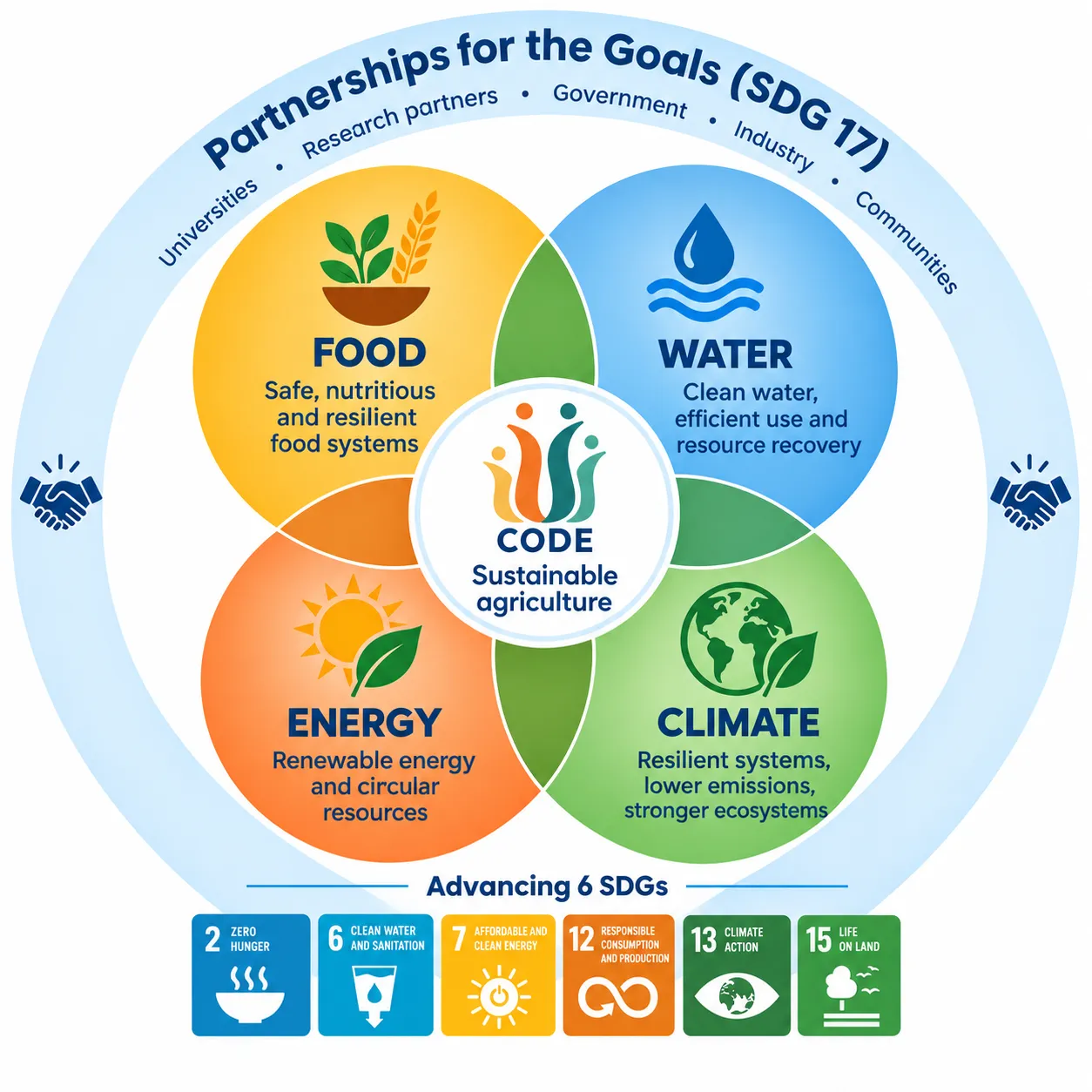
Food security cannot be won by growing more food alone. It depends on water, energy and a stable climate, held together by partnership.
- FoodSafe, nutritious and resilient food systems: climate-smart crops, agroforestry, livestock health, bees and fish.
- WaterClean water, efficient use and resource recovery: rainwater harvesting, irrigation, safe reuse and quality testing.
- EnergyRenewable energy and circular resources: solar pumping, cooling and processing, composting and biogas.
- ClimateResilient systems, lower emissions and stronger ecosystems: soil restoration, woodlots and climate-resilient farming.
Strategic alignment
Six goals, one partnership.

SDG 1: No Poverty
New income from farm enterprises, bees, fish and trees; jobs for young people.

SDG 2: Zero Hunger
Higher productivity, reduced post-harvest losses and climate-smart production.

SDG 6: Clean Water and Sanitation
Rainwater harvesting, safe water reuse, water quality and sanitation.

SDG 7: Affordable and Clean Energy
Solar-powered irrigation, cooling and processing; biogas.

SDG 13: Climate Action
Agroforestry, soil restoration and climate-resilient farming systems.

SDG 17: Partnerships for the Goals
Multi-stakeholder university consortia, shared resources and co-financing.
The partnership also supports SDG 12 (Responsible Consumption and Production) and SDG 15 (Life on Land), and aligns with the African Union’s Agenda 2063, CAADP and SADC’s Regional Indicative Strategic Development Plan.
Proposed next steps
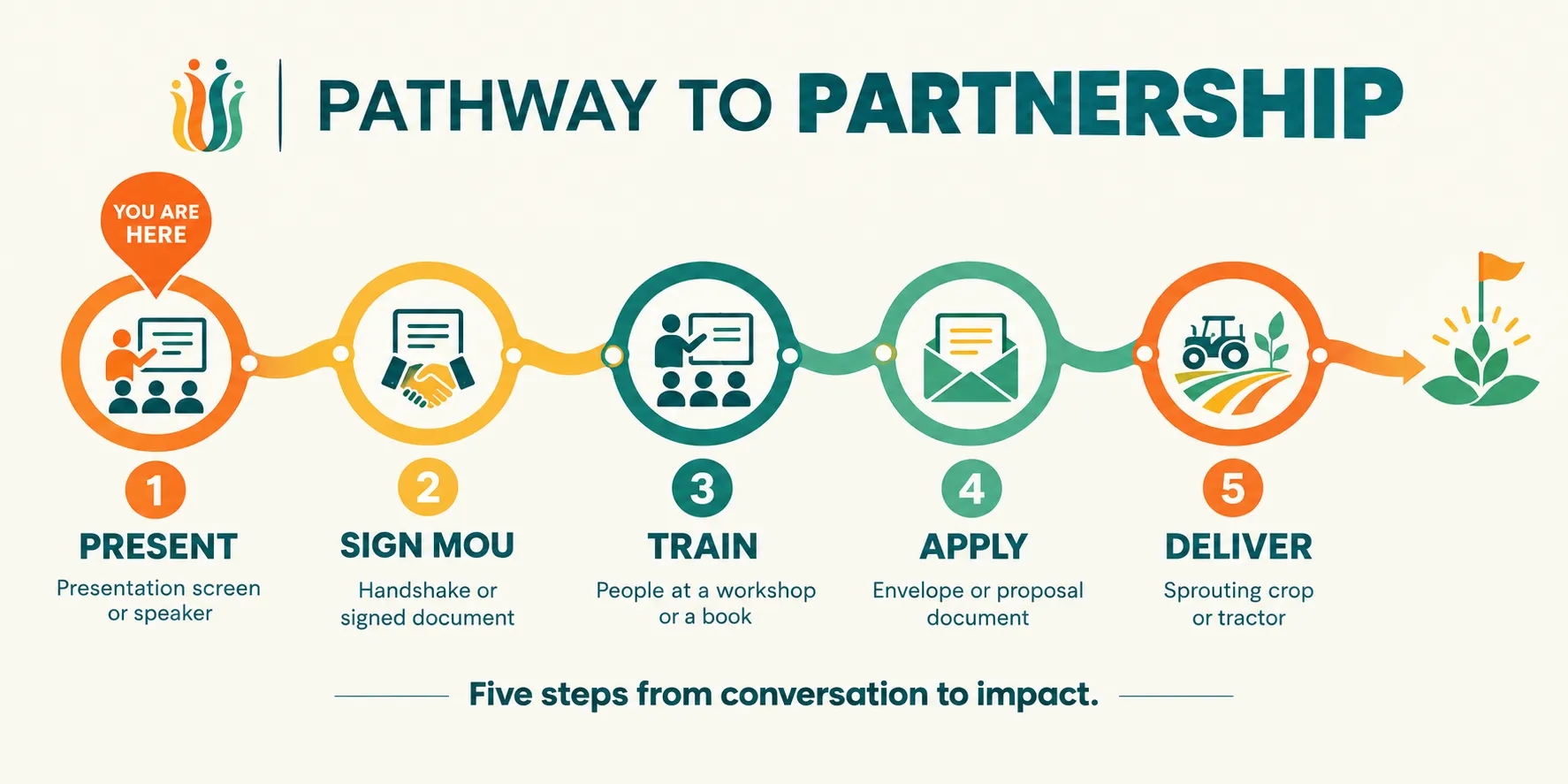
Pathway to partnership.
Step 1
Stakeholder presentation
CODE presents the concept in person to university leadership, research offices and agriculture faculties.
Lead: CODE
Step 2
Memorandum of understanding
Interested institutions and CODE sign an MOU setting out shared goals, roles and ways of working.
Lead: CODE and partners
Step 3
Grant application and management training
Workshops for research teams on finding calls, writing winning proposals and managing funded projects.
Lead: CODE
Step 4
First joint grant application
CODE co-develops a consortium bid on a priority sustainable agriculture challenge.
Lead: Consortium, supported by CODE
Step 5
Project management and delivery support
Once funded, CODE supports implementation, technical delivery and reporting.
Lead: Consortium and CODE
Bring your institution to the table.
Sustainable agriculture will not be achieved by any one institution or discipline alone. Let’s meet to explore how your institution can lead and benefit from a regional partnership.